Tin Whiskers
- Brief Description
-
Tin whiskers are small columns of metal that spontaneously grow from metalic surfaces, especially surfaces plated with tin or zinc. They are a relatively new problem as most platings and solder used to contain lead, which inhibits whisker growth. However due to health concerns lead has been banned in most applications causing an increase in products on the market with tin whiskers. Tin whiskers are still not very well understood but can cause lots of problems. For a list of products which have been lost due to tin whiskers, see Link 1. They have been observed at up to 10 mm long and 10 um in diameter. They are highly ductile often bending rather than breaking.
- Growth
-
Tin whiskers have been observed to grow between 0.03 and 9 mm per year. The reason for their growth and the growth mechanism are not well understood, but two main theories exist. The primary theory is that it is a mechanism for stress relief, especially compressive stresses. To grow, the metal in the surface must diffuse which causes the whiskers to grow. Tin whiskers always grow from the base. Tin whiskers have an incubation period between days and years making detection even more difficult. See Link 2 for videos of tin whisker growth. The following have been observed to affect whisker growth.
-
- Plating method: Shiny surfaces, especially those with more organic compounds increase whisker growth.
- Intermetallic relationships: The alloys, especially copper have been shown to change whisker growth. Copper forms intermetallic compounds such as Cu6Sn5, which alter the structure, possibly leading to increased stresses. Brass has been shown to be the worst substrate from a whisker point of view.
- External compressive forces: Where tin plated surfaces are clamped or are near fasteners there is an increased chance of whisker growth.
- Bending and stretching: If the piece was bent or stretched, especially before it is mounted more whiskers have been observed to grow.
- Scratches and nicks: Increased surface damage leads to more whisker growth.
- Mismatches in thermal expansion coefficients: This is also likely due to a buildup in internal stresses which leads to increased whiskers.
- Thickness: 3-8 micron platings have been shown to be especially prone to whiskers.
The following environmental factors have been shown to possibly increase the growth of tin whiskers. However, there is conflicting data, and in some experiments these conditions were observed to have no effect.
-
- Temperature: 25-50 C is optimal, above 150 C there is no growth.
- Pressure: No correlation has been observed.
- Moisture: Higher humidities (above 85%) have been seen to increase growth.
- Thermal Cycling: especially if there is a mismatch in thermal expansion coefficients it has been shown to increase growth.
- Electric Fields: Have not been shown to change growth, though can cause the whiskers to bend towards them, thus increasing the likelihood of a short.
- Prevention
-
The best way to reduce the risk of tin whiskers is to not use tin or other whisker-prone metals. Nickel for example does not grow whiskers. Adding 3% lead has been shown to virtually eliminate tin whisker growth. Applying a conformal coat or encapsulating the part greatly inhibits the ability of tin whiskers to grow. In general avoiding the things outlined above as increasing the growth reduces the chances of whisker growth.
- Characteristics
-
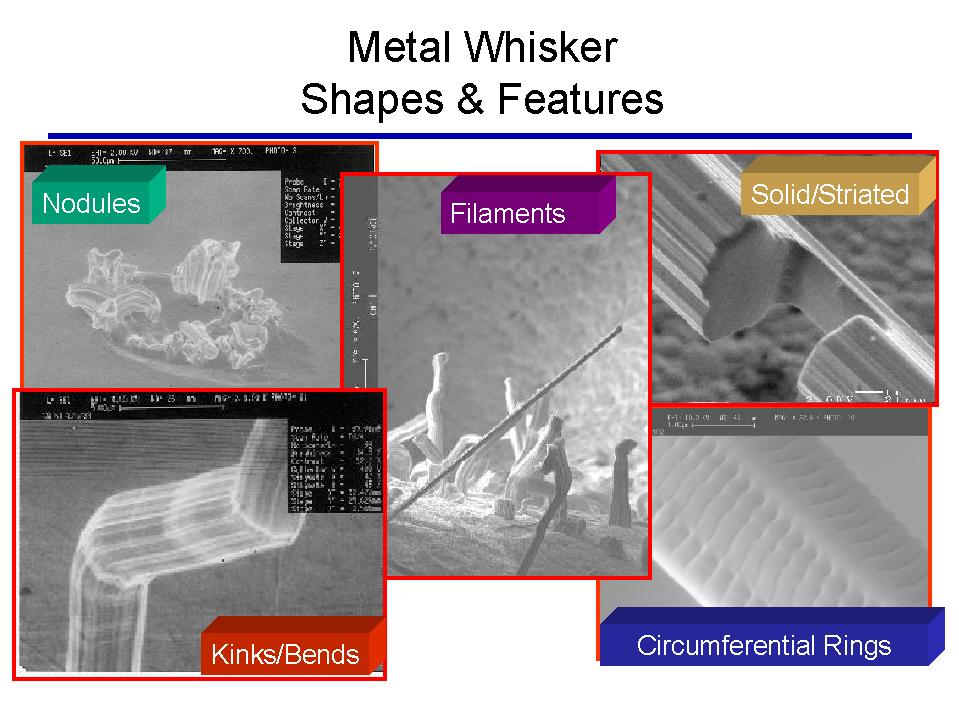
Shape: straight, kinked, etc, see Link 3 for pictures of them.
Length: up to 10 mm, see Link 4 for a paper on tin whisker size.
Diameter: 0.006 - 10 um, also described in Link 4.
Incubation: days to years.
Growth rate: 0.03 - 9 mm per year.
- Links
- [1] Whisker Failures, NASA.
- [2] Sn Whiskers, Brown University.
- [3] Metal Whisker Shapes and Features, NASA.
- [4] Evaluation of Environmental Tests for Tin Whisker Assessment, Maryland University Digital Repository.
- For More Information
- [1] Tin WHisker Homepage, NASA.
- [2] Whisker, Wikipedia.
- [3] Index of Articles and Papers on Whiskers, HL Instruments.
- [4] How do whiskers and hillocks grow in Pb-free Sn coatings, Brown (hosted by NASA) [PDF].
- [5] Metal Whiskers from Sn-Ag-Cu Alloy Systems, NASA.
|
|