Our project leveraged the established SALG (Student Assessment of Learning Gains) instrument to evaluate students’ perceived learning gains at the end of the semester. However, interpreting these results in isolation proved challenging because we lacked insight into what students knew before taking the course. This realization led to the development of the SALF (Student Assessment of Learning Familiarity) survey—a complementary pre-course instrument aligned with SALG. This paired approach gives instructors a simple, structured way to generate evidence of student learning and reflect on instructional effectiveness.
The SALG is a tool for gathering formative feedback on instructional practices and student learning. The SALG is administered at the end of the semester and asks students to report how specific course elements (e.g., activities, assignments, instructional techniques) helped their learning, along with their perceived learning gains in content knowledge and skills. (Note: this instrument was developed from a chemistry course study comparing instructionally traditional and innovative courses across eight institutions and has been adapted to work across disciplines.)
The SALF adapts this structure for the beginning of the semester. It asks students to reflect on their prior familiarity with core course concepts and their previous experiences with instructional techniques. This provides instructors with a baseline understanding of:
Students’ prerequisite knowledge
Areas of confidence or uncertainty
Preconceived expectations about teaching approaches.
With this information, instructors can make early adjustments, including clarifying assumptions, reinforcing foundational concepts or proactively addressing likely sticking points.
At the end of the semester, the SALG can be used to measure perceived learning gains on the same or closely aligned items. When paired thoughtfully, SALF and SALG enable instructors to:
Compare pre-course familiarity with post-course learning gains,
Identify areas of significant growth or persistent gaps, and
Generate evidence of student learning for reflective teaching or reporting purposes.
With careful survey design (e.g., anonymous matching codes), responses can be linked at the individual or aggregate level, allowing for both class-wide analysis and deeper insights into individual learning trajectories.
For an example of the survey in action, consider this example from the Civil Engineering Statics course from Fall 2025.
In the SALF survey, student responses revealed that they favored traditional lecture-based structure supplemented with occasional group work and hands-on activities. Furthermore, as they reflected about prior courses they described learning best through a “you do, we do, I do” approach. This told the instructor that he needed to be clear about the purpose and decision to implement the planned collaborative course design.
Then came the SALG survey at the end of the semester. We were ecstatic to see there was a notable positive shift in perceptions! Students increasingly pointed to hands-on learning strategies and they highlighted the benefits of structured group work for deepening their understanding.
How to Get Started:
Adapt the SALF and SALG questions to match your course content
Administer the SALF early in Week 1
Review the results
Administer SALG in the last class
After the semester, review SALG data alongside SALF results to identify patterns in student growth, and refine future course design.
For more details see our paper at the ASEE 2026 Annual Conference & Exposition linked here.
We are currently working on detailed class preparation for a hands-on version of statics in which we attempt to explicitly teach the process of problem abstraction. That is, we start with physical objects and develop tractable engineering mechanics problems. Only then will we introduce theory and analysis techniques. The physical objects will be small-scale analog models of everyday objects that our students come into contact with, such as bridges, roof trusses in big-box stores, their own body, or a crane. The students will build and experiment with the models under different loading. While I am excited to teach this class in the fall of 2024, the class preparation is not easy. So, I wanted to write about some of the challenges we are facing. The main challenges are buy-in, object identification, object incorporation, and timing.
First, a little background. The class will be taught every Tuesday and Thursday for 75 minutes each day with between 40 and 44 students. There will be a total of 27 classes over the semester. Assuming a few tests and a review day, that leaves 23 class periods to work on all the material in the syllabus. My section will be one of 6 sections and my student’s will need to learn the same material as everyone else. The class will have students majoring in civil, environmental, industrial, biosystems, and biomedical engineering.
Buy-in
While the research team has bought into the project at an intellectual level, we are all still connected to the traditional lecture approach (motivation, theory, example, example, more theory …) to organizing an engineering class period. We all, to varying degrees, still want to put the theory first. For example, if we want to talk about 2D equilibrium at a point, then surely we need to explain that force is a vector before we can get started. The problem with this approach is that mental step is part of the abstraction process. Putting the theory first immediately limits student’s thinking. Our goal is to have them discover that force is a vector by interacting with the everyday objects they see around them. Further, the more complex the problem, the greater the temptation to put the theory first.
Identifying objects
The main challenges with object identification are number, location, diversity, complexity, and scale. Our current thinking is that we will have time to analyze two objects per class period. That means we need to identify around 45 everyday objects that we can analyze and that allows students to learn all the material needed in the class. To create an additional challenge, we plan to publish all our class materials online so we would prefer to use objects that we have taken photos of ourselves to avoid any copyright infringement issues. This means that the objects need to be local to Clemson, South Carolina, or other locations the research team travels to. While there are a lot of objects to find, it can be a challenge to find a broad enough range to cover all the topics in the class. To overcome both the volume and location challenge we ran a survey in a dynamics class prompting students to suggest objects they might like to analyze. We used dynamics as all the students would have completed statics. Students were asked to upload a photo of an object and then pose a question about it that could be answered using the knowledge and skills they learned in statics. While this provided several ideas for objects, the related questions were often too vague for direct use. We will be using a similar approach during the trial classes but with more detail on expectations.
Diversity and complexity are also a major challenge. While we currently have over 100 objects that we have collected photos of, we will likely need more to complete the entire course. Our diversity goal is to find a broad set of objects that are relevant to all the different majors represented in our classroom. For example, we want to include biomechanics problems for the biomedical engineers, workstation objects for the industrial engineers, and maybe an irrigation system for the biosystems engineers. In addition, we need to find objects with an appropriate range of complexity. For example, when we discuss trusses, we can’t only analyze big-box store roof trusses. At the same time, analyzing the forces in a three-dimensional crane truss is likely too complex for a first class in statics.
Finally, we want our students to understand the real-world scale of these objects. That is, we want them to have a feel for the actual loads that might be applied to an object, and to have a physical context for different weights and forces. These insights could get lost in the process of working with small-scale models. To address this problem, we are developing a graphical scale dictionary. The dictionary contains photographs of familiar objects, such as a gallon of milk or a minivan, and their approximate size and weight. We currently have objects ranging in weight from 0.5 lbs. to 80,000 lbs.
Incorporating objects
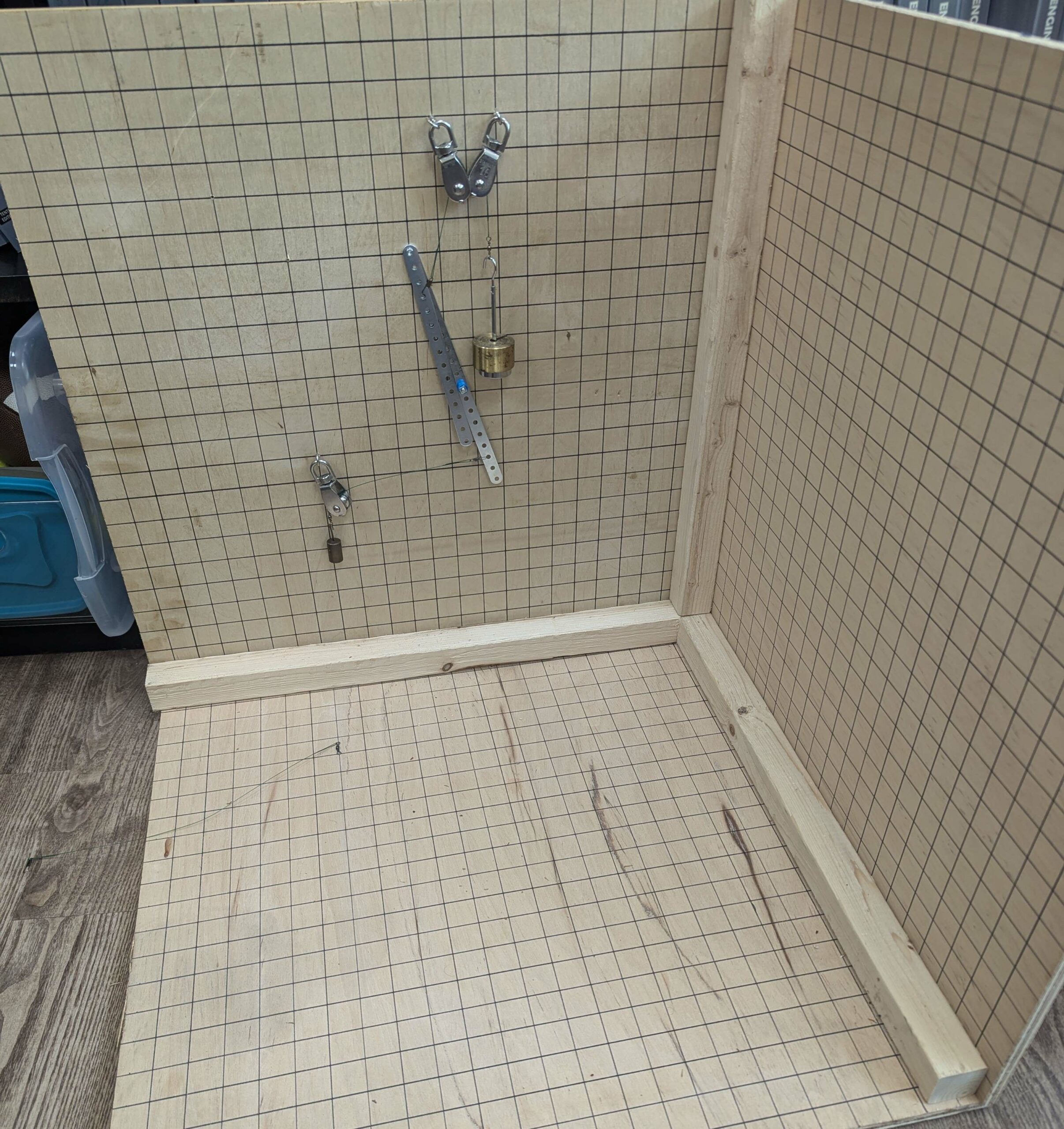
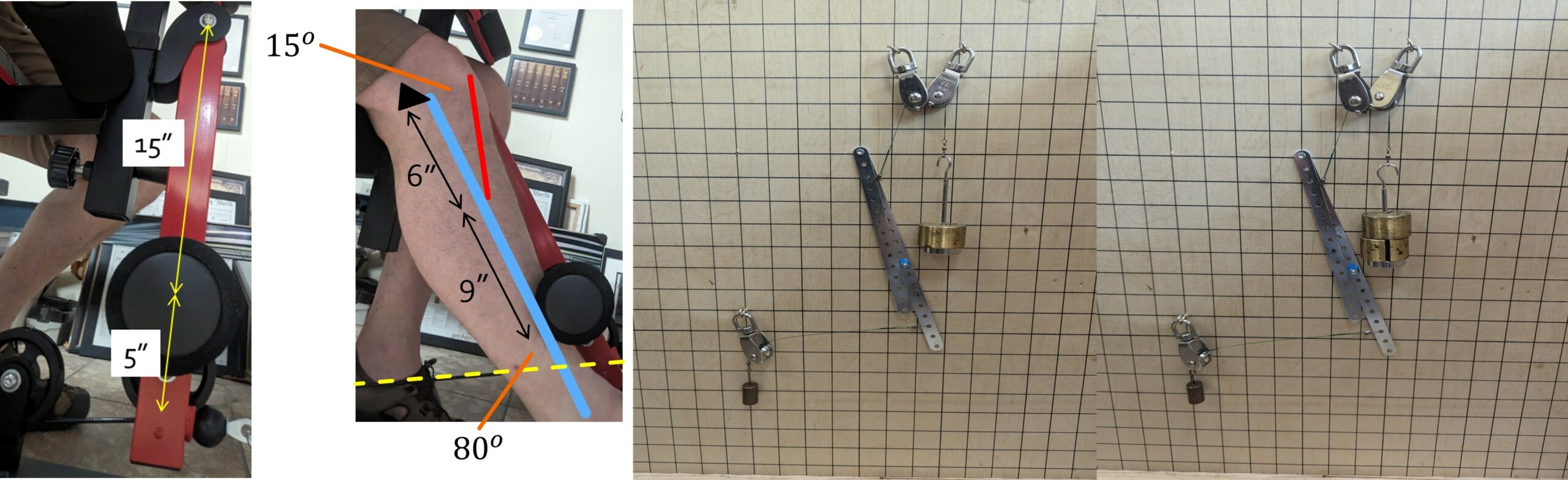
Having identified a particular object for a particular topic, we then have to incorporate it into the lesson plan. This requires several steps. The simplest step is to develop a physical model that students can play with. We have been doing that with Knex systems, Erector sets, weights, pulleys, cables, and spring balances. We are also building some wooden 3-sided 2-foot cubes for mounting the models on (see figure 1.) We expect to have students work in teams of four so we will need 10-11 of everything. As we build the models, we need to make sure that they are manipulable so that students can explore their behavior and not simply look at them. Figure 2 shows an example of a physical object (leg extension machine) and the analog model we could use in class to understand how the system behaves.
Figure 1. Image of the three sided cube to be used for building analog models for class. Figure 2. From left to right: image of a leg extension machine, the machine being used, and an analog model with two different loadings on the leg with resulting change in angle.
The greater challenge is working out how to introduce the objects and guide a conversation with the students about how to analyze the object. We do not want to ask questions like, “What is the reaction at the pin support?” as that is too specific and bypasses much of the abstraction process. Instead, we may want to ask, “What keeps it from falling over?” When students are experimenting with an object, it will be important to focus their observations on certain questions such as, “What happens to the tension in the cable when you change its angle?” However, this is a delicate balance. We want students to explore on their own terms but we also want to guide them toward questions that allow the instructor to introduce the theory that they need to solve the problem. This is an ongoing struggle, and we will likely not get it right before the first time teaching the class.
Class timing
Each class period will be 75 minutes long and will include time for a mental break toward the middle of that period. We have many goals for this class period including having student groups report out their results from homework problems, working through abstraction and analysis of objects, presentation of theory, introduction of the next set of homework problems, and an exit activity.
Our current plan is to have the student groups do three homework problems before each class. They will then report out their solutions to the other students at the start of the class period. We will do this in a range of ways including having them all write out their solution to one of the problems on a board and then have them explain it to another group, have them present at the front of the classroom, or some other variation.
Next, we will work on the objects of the day. This will include showing a range of objects that relate to the topic of the day and then focusing on one for modeling. We will then guide a discussion of what we might want to know about the object and what they can apply that they already know. This could include experimenting with the small-scale analog models of the object. The conversation will be guided toward a particular set of problems with flexibility to allow students to propose their own problems. Then, and only then, will we introduce any theory. This will be kept to an absolute minimum to enable the students to solve the problem at hand. The students will then solve a problem related to the object. We hope to work through two objects per class.
Finally, we will introduce the homework problems due at the start of the next class and conduct some sort of exit activity such as a muddiest point question or having them sketch a free body diagram for one of the homework problems.
The timing challenge is that we want to provide students with the opportunity to explore during the discussion of objects and while experimenting with the analog models. However, we also must get through the technical content of the syllabus. This will require a lot of flexibility from one class to the next and experimenting with timing over the course of the semester. We will be tracking the timing in each class, with the help of graduate student assistants, so that we can reorganize the material for future semesters.