background

High-Performance Off-Road Autonomy   

Collaborator: VIPR-GS

Students: Abdullah Kose, Benjamin Johnson, Vasudev Purohit, Olamide Akinyele,  

Overview

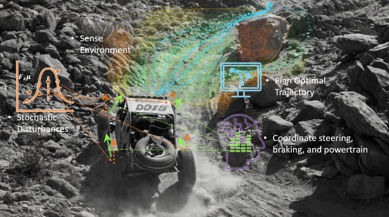
Off-road autonomy cannot be treated as a sequence of independent perception, planning, and control modules. At mission-relevant speeds, what the vehicle can see, learn, plan, and physically execute changes simultaneously. Our research develops integrated decision-making methods that account for visibility, terrain uncertainty, vehicle dynamics, actuation, propulsion, and thermal constraints before committing to an action.

Navigating the way a human would: see (camera and vision), reason, and commit to calculated risks – without stored maps or waypoints

Navigating Beyond What the Vehicle Can See

Off-road vehicles must act before hidden terrain is fully observed. Our controller predicts how motion changes future visibility, slowing or redirecting the vehicle to reveal safer options. In cluttered simulation, success improved from 8% to 84%; full-vehicle tests confirmed earlier, safer responses near occlusions.

Learning the Terrain While Driving

Traction and vehicle behavior can change abruptly across soil types. Our controllers make small, purposeful maneuvers when learning is valuable, identify friction and terrain behavior earlier, and adapt speed and steering before limits are exceeded—turning uncertainty into information while continuing the mission.

blog
Combining Global Foresight with Local Adaptation

Global maps provide foresight but cannot capture every new obstacle or terrain change. We combine learned long-range guidance with real-time local planning and fresh sensor updates. The framework achieved up to 70% higher success rates while using up to 90% fewer planning samples than baseline MPPI.

blog
Making Plans the Vehicle Can Actually Execute

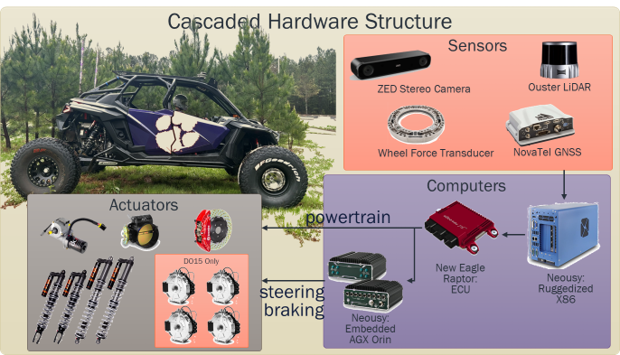
A safe path is useful only if the vehicle can execute it. We integrate planning with steering, braking, propulsion, suspension, energy, and thermal constraints, then evaluate the resulting strategies through simulation, dynamometer-based testing, and full-scale vehicle demonstrations.

blog blog
Selected Publications

1. B. Johnson, , Q. Zhu, et. al, “Implicit Dual-Control for Visibility-Aware Navigation in Complex Off-Road Scenarios”, submitted to IEEE Transactions on Robotics (https://www.arxiv.org/abs/2507.04371)

2. A. Ghate, O. Akinyele, Q. Zhu, et al., “Cascaded RL-MPPI framework for Off-Road Vehicles: Integrating Global Maps and SLAM”, IEEE Open Journal of Intelligent Transportation Systems, vol. 7, pp. 41-60, 2025

3. V. Purohit, Q. Zhu, et al. “ADAPT Planner: Adaptive Dual Control for Active Planning Under Traction Uncertainty”, Accepted by 2026 ACC

4. V. Purohit., Q. Zhu, R. Prucka, et al., “Online Model Discrimination Using Dual Model Predictive Path Integral Control”, Accepted by 2026 ACC

5. Z. Feng, H. Zhan, Z. Chen, Q. Yan, X. Xu, C. Cai, B. Li, Q. Zhu, and Y. Xu, “NARUTO: Neural Active Reconstruction from Uncertain Target Observations”, Proceedings of the IEEE/CVF Conference on Computer Vision and Pattern Recognition (CVPR), 2024, pp. 21572-21583

Contact Us

Qilun Zhu, Ph.D.
Research Associate Professor
qilun@clemson.edu
(864) 283-7239
4 Research Drive
Greenville, SC 29607