
Overview
Electrified tracked vehicles must deliver mobility, efficiency, compact packaging, and short-duration power across missions where turning and terrain shape loads as much as speed. Our research connects representative mission generation, vehicle and powertrain simulation, control analysis, and architecture design. The work progresses from full-scale series-hybrid prototypes to a power-split architecture now being assessed across broader vehicle classes.
Mission-Based Design and Full-Scale Prototyping
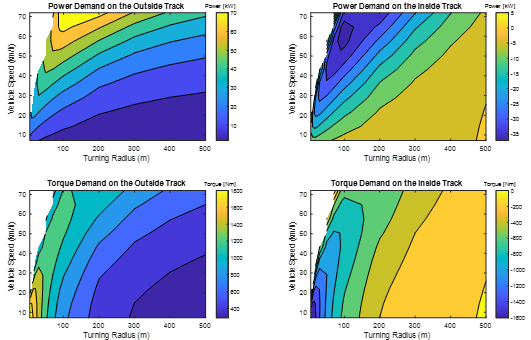
Tracked vehicles cannot be designed from speed alone. Grade and turning strongly shape total power demand, while left- and right-track loads can differ substantially. We generate statistically representative mission cycles and use them with system models to size components, compare controls, and avoid designs optimized for only one scenario.

Deep Orange 13 and 14 translated these requirements into full-scale series-hybrid tracked platforms. Their development supplied realistic constraints, packaging experience, and field data that continue to support powertrain modeling and architecture studies.
The Deep Orange vehicles demonstrate how mission requirements, system modeling, powertrain design, vehicle packaging, autonomy, and rapid prototyping can be brought together in a complete vehicle development program.


https://www.clemson.edu/cecas/deeporange/projects/do13.html
Powertrain Architecture Innovation and Scaling
Series hybrids offer packaging flexibility and high electrical power, but repeated energy conversion and large electrical components create trade-offs. Our Power Split Hybrid Electric Tracked Vehicle (PS-HETV) concept coordinates mechanical and electrical power paths to improve mission efficiency, reduce component size, and sustain high-demand maneuvers for longer.

The architecture was evaluated against conventional, series-hybrid, and parallel-hybrid alternatives using common mission requirements and supervisory control assumptions. Published results indicate advantages in energy efficiency, packaging, electrical-component sizing, and sustained burst-power operation. For 3.5 ton DO13 class, the PS-HETV design demonstrates the following advantages:
1. Higher range: 15% more than series or parallel; 24% more than conventional (engine + hydrostatic steering)
2. More compact design: VS. Parallel: no gear-changing transmission and steering hydraulics VS. Series: 50% smaller motors, 15 - 50% smaller battery pack VS. Conventional: similar weight, 37% less space
3. Engine-only mode possible
4. Longer ‘burst mode’ operation: allow motors to run below base speed, preventing demagnetization: here is an example of vehicle traveling at 30 km/h while executing a 50m radius turn. PS-HETV can reduce traction motor speed below base speed, enabling stronger and longer burst operation

5. Better reverse performance (vs. Parallel)
6. Better external electrical power supply: More power than parallel Higher part load efficiency than series
Publications and Intellectual Property
Technical methods, assumptions, and quantitative comparisons are available in the publications below.
Selected Publications
1. D. Egan, A. Sundar, A. Kumar, Q. Zhu, and et al., “Synthesis of Statistically Representative Driving Cycle for Tracked Vehicles”, SAE Technical Paper, no. 2023-01-0115, April, 2023
2. Q. Zhu, A. Kumar, A. Sundar, D. Egan, et al., "Development of a Series Hybrid Electrified Powertrain for a High Speed Tracked Vehicle Based on Driving Cycle Simulation," SAE Int. J. Adv. & Curr. Prac. in Mobility 4(4):1403-1412, 2022, https://doi-org.libproxy.clemson.edu/10.4271/2022-01-0367.
3. A. Ghate, A. Sundar, Q. Zhu, R. Prucka, and et al., “A Novel Power-Split Hybrid Electric Architecture for Off-Road Tracked Vehicles: Design and Performance Evaluation”, SAE Technical Paper, no. 2026-01-0258, Apr., 2026.
Intellectual Property
“Hybrid Electric Powertrain for Tracked Vehicles,” U.S. Patent Application No. 19/304,819.
Related Vehicle Programs
Contact Us
Qilun Zhu, Ph.D.
Research Associate Professor
qilun@clemson.edu
(864) 283-7239
4 Research Drive
Greenville, SC 29607